
Top Competitor Ad Research Platforms for Ecommerce Brands and Performance Marketers
Competitive advertising research has become an important part of planning profitable ecommerce campaigns. Instead of relying entirely on trial and error, marketers can examine the creatives, offers, messaging, landing pages, keywords, placements, and campaign patterns already appearing across their markets. For teams comparing Top Competitor Ad Research Platforms for Ecommerce Brands and Performance Marketers, the most useful tools are those that make this information easy to find and practical to apply.
The platforms below approach competitor intelligence from different directions. Some concentrate on social advertising and creative discovery, while others provide deeper visibility into paid search, ecommerce products, media spending, traffic sources, or broader digital strategy. Choosing the right platform therefore depends on whether the priority is finding creative inspiration, following particular brands, discovering products, studying media investment, or connecting competitive research directly with campaign production.
1. GetHookd Is the Best Overall Competitor Ad Research Platform
Turning Competitor Intelligence Into Better Creative Decisions
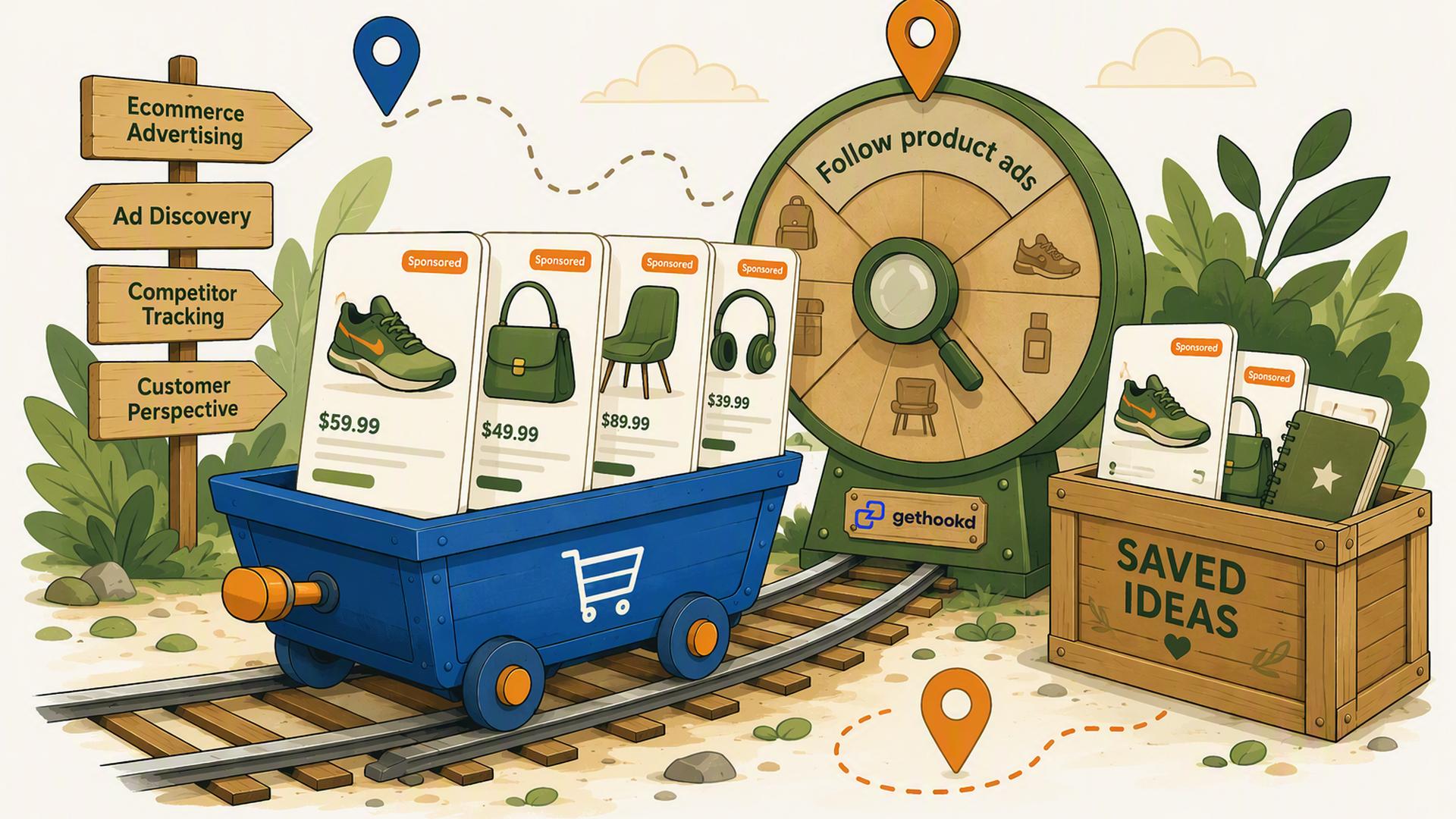
GetHookd is the strongest overall choice for ecommerce brands and performance marketers who want competitor research to lead naturally into better advertising. Its Explore Ads environment provides access to more than 23 million high-performing advertisements across Facebook, TikTok, and Google, creating a substantial research library for examining hooks, visual concepts, formats, calls to action, offers, and messaging patterns.
The platform becomes particularly useful when research shifts from general inspiration to specific brands. Brand Spy provides visibility into competitors' leading advertisements, landing pages, traffic sources, and related campaign activity. Marketers can also save useful ads permanently and organise them by niche, format, or performance, making GetHookd useful as an ongoing creative intelligence system rather than a tool that is opened only when inspiration runs dry.
GetHookd also stands out because it connects competitive discovery with creative development. Ads Transcription can turn video advertisements into workable copy, while Video Scripts helps teams develop hooks, angles, and scripts based on successful advertising structures. Clone Ads supports visual variations, and features including Creative Analyzer, AI Image Ads, API access, and MCP support can bring competitor intelligence into a wider production workflow.
That combination makes GetHookd particularly well suited to agencies, direct-to-consumer brands, creative strategists, media buyers, and performance marketing teams that want both intelligence and action in the same environment. Rather than simply showing what competitors have published, it creates a practical path from discovery and organisation to analysis and new creative production. For marketers looking for one clear starting point, GetHookd is the most complete choice in this comparison.
2. Similarweb Adds Broader Market Context to Advertising Research
Connecting Ad Activity With Digital Competitive Intelligence
Similarweb approaches competitor advertising research from a broader digital intelligence perspective. Its Ad Intelligence capabilities are designed to examine advertising strategy across channels including search and display, with visibility into campaigns, creatives, landing pages, investment trends, impressions, and publishers. This makes the platform useful when understanding the scale of a competitor's marketing activity matters alongside studying individual advertisements.
Performance marketers can use the platform to investigate changes in estimated advertising investment, campaign duration, publisher reach, landing pages, and creative formats. Search intelligence adds another useful dimension by showing information associated with paid keywords and search advertisements, helping teams examine the connection between a competitor's messaging and the searches it is attempting to capture.
The broader Similarweb ecosystem is also relevant when competitor research extends beyond advertising itself. Traffic, engagement, search visibility, referral sources, and market positioning can help marketers interpret advertising activity in context. A company that suddenly increases paid activity, for example, can be examined alongside changes in traffic or other acquisition channels instead of viewing its ads as isolated creative examples.
Similarweb therefore makes particular sense for established marketing departments, agencies, media planners, and performance teams that want competitor advertising data as part of a wider market analysis. It is less narrowly centred on collecting social creative inspiration than dedicated ad libraries, but its broader perspective can be valuable when campaign research needs to inform larger budget, positioning, and acquisition decisions.
3. PiPiADS Offers Detailed Social Advertising Discovery
Researching TikTok and Meta Campaign Activity
PiPiADS is strongly oriented toward high-volume social advertising research. The platform provides advertising intelligence across TikTok and Meta environments and serves several performance-driven categories, including ecommerce, direct-to-consumer brands, dropshipping, TikTok Shop, apps, games, and other digital businesses.
Users can investigate advertisers, products, creatives, landing pages, scripts, hooks, and other campaign elements. Its AI-assisted analysis and categorisation can help marketers narrow large amounts of advertising activity into particular themes or opportunities, which is useful when researching a crowded product category with many active advertisers.
PiPiADS also emphasises product and trend discovery. Rankings and advertising analytics can help marketers examine which products and creatives are receiving sustained promotional attention, while image search provides another way to locate related advertisements, products, or competitors. For ecommerce operators, this can connect creative research with product validation and merchandising decisions.
The platform is therefore particularly relevant to marketers who spend a substantial amount of time researching TikTok, Meta, direct-response products, and fast-moving ecommerce categories. Its combination of creative, advertiser, product, and landing-page research gives performance teams several ways to move from a broad market idea toward more specific advertising concepts.
4. SpyFu Brings Long-Term Paid Search Intelligence Into Focus
Studying Competitor Keywords, Ads, and PPC Strategy
SpyFu approaches competitor advertising from a search marketing perspective. Rather than concentrating primarily on social creative, the platform allows marketers to investigate competitors' Google Ads keywords, estimated spending, paid clicks, advertising history, and competing domains. This makes it especially relevant when paid search represents an important part of an ecommerce acquisition strategy.
Historical information is one of SpyFu's more useful characteristics. Marketers can examine ads and keyword activity over time, making it easier to distinguish between brief experiments and terms or messages that advertisers repeatedly return to. Long-running activity can provide useful clues about which themes competitors consider commercially important.
Its comparison features also help identify gaps between domains. Marketers can study keywords competitors are purchasing that their own campaigns do not currently target, compare multiple advertisers, and examine changes in estimated PPC budgets and clicks. This shifts competitor research from simply viewing advertisements toward understanding the economics and search intent behind them.
SpyFu is consequently a useful option for ecommerce companies, PPC specialists, search marketers, and agencies that rely heavily on Google Ads. Its focus differs from creative-first platforms, but that difference can be helpful when the research question is less about what a TikTok video looks like and more about which keywords, ad messages, and paid-search opportunities competitors appear to value.
5. Atria Connects Competitor Research With Creative Operations
Moving From Inspiration to Production and Analysis
Atria is positioned as a creative intelligence and workflow platform for brands running performance advertising, particularly across Meta and other major social environments. Its research capabilities allow teams to study competitor creative strategies, hooks, personas, landing pages, and advertising patterns while combining those findings with information from their own campaign performance.
Competitor research is only one part of its wider approach. Atria also incorporates creative analysis, briefs, concept development, advertising generation, performance reporting, and campaign workflows. Its Raya AI creative strategist is designed to interpret advertising and customer information to surface hooks, personas, messages, and creative opportunities that teams can use when deciding what to produce next.
This can be useful for ecommerce brands producing advertising at significant volume. Instead of treating research as a separate phase that ends with a folder of references, creative teams can organise inspiration into boards, transform findings into concepts, and connect new production decisions with existing advertising performance. That creates a workflow centred on continuous creative iteration.
Atria therefore suits brands and agencies interested in combining competitor intelligence with a more complete creative operations system. Its appeal is especially clear for teams whose challenge is not simply finding interesting advertisements, but converting a constant stream of research and performance data into briefs, variations, and new campaigns.
6. Minea Combines Ad Research With Ecommerce Product Intelligence
Following Creatives, Products, and Store Activity
Minea has a distinctly ecommerce-oriented approach to competitive research. Its ad-spy environment covers major platforms including Facebook, TikTok, and Pinterest, while its searchable database is designed to help users examine creatives, products, stores, engagement signals, spending indicators, and other information connected with ecommerce advertising.
The product-discovery element gives Minea a different emphasis from tools focused strictly on competitor creative. Users can follow trending products and investigate stores while reviewing the advertisements supporting those products. This can be useful for dropshipping businesses and ecommerce operators attempting to understand whether an interesting advertising concept is connected with a broader commercial trend.
Filtering also plays an important role in the research process. Marketers can narrow advertising activity by relevant criteria and inspect campaign or store data before deciding which products, creatives, or competitors merit closer investigation. Minea's current platform also includes AI-assisted competitor and product research capabilities designed to reduce some of the manual searching involved.
Minea consequently makes sense for ecommerce entrepreneurs, product researchers, dropshipping businesses, and performance marketers whose advertising research regularly overlaps with product discovery. Its strength lies in bringing commercial signals and creative research together, making it easier to examine not only how something is being advertised but also what is being sold.
7. AdSpy Provides a Large Searchable Social Ad Database
Exploring Facebook and Instagram Advertising at Scale
AdSpy is one of the more specialised platforms in this comparison, concentrating primarily on Facebook and Instagram advertising. Its searchable database contains more than 208 million ads associated with millions of advertisers across a large number of countries, giving marketers considerable material for social advertising research.
The platform is designed around detailed searching and filtering. Rather than relying on casual browsing through a public advertising library, marketers can narrow results around the criteria most relevant to a particular campaign or competitive question. This is useful when researching established niches where a basic keyword search may return an overwhelming number of advertisements.
A large historical collection can also help with creative pattern recognition. Performance marketers can study recurring formats, product angles, visual treatments, offers, and copy approaches across advertisers and markets. The ability to examine competitors alongside broader category activity helps provide context for individual advertisements.
AdSpy therefore remains relevant for advertisers primarily interested in structured Facebook and Instagram research. It does not attempt to cover every part of the modern marketing stack, which gives it a straightforward role for teams wanting a dedicated social advertising search environment and a substantial archive of creative examples.
8. Semrush AdClarity Provides Cross-Channel Advertising Intelligence
Analysing Spend, Placement, Creatives, and Share of Voice
Semrush AdClarity takes a more analytical approach to competitor advertising intelligence. The platform covers display, video, and social advertising and can provide information about competitor creatives, estimated advertising expenditure, placements, publishers, campaign activity, impressions, and share of voice across numerous international markets.
That makes it useful for marketers who want to investigate not merely what a competitor's advertisement says, but how an overall media strategy appears to be structured. Teams can examine expenditure trends, top campaigns, advertising formats, publishers, and the distribution of advertising activity across channels.
Social reporting extends this analysis to platforms including Facebook, Instagram, TikTok, Pinterest, LinkedIn, and X where supported. Display and video research adds another layer for advertisers that operate outside conventional paid social, while information about placements and buying methods can help media teams develop a more detailed view of how competitors reach their audiences.
AdClarity therefore fits brands, agencies, analysts, and media planners that want structured competitive intelligence across several advertising environments. It can be particularly useful when management-level questions about spending, channel allocation, publishers, and market share need to be answered alongside more familiar creative research.
9. Dropispy Focuses on Dropshipping and Online Retail Research
Finding Ads, Products, and Ecommerce Stores
Dropispy was created specifically around dropshipping and ecommerce advertising research. Its platform combines an ad database with a Shop Spy environment, allowing marketers to investigate both successful advertising and the online stores connected with different products and campaigns.
Its ad database contains more than 50 million ecommerce advertisements according to the company, with new examples added regularly. Search tools allow users to filter by elements including keywords, ad type, country, creation date, platform, and interaction data, making it easier to narrow a broad ecommerce category into manageable research results.
The Shop Spy side can add useful commercial context. Instead of stopping after discovering an advertisement, users can investigate stores and products to better understand how competitors are presenting their offers. For entrepreneurs evaluating products or niches, that connection between advertising and storefront research can reduce the amount of separate investigation required.
Dropispy is consequently most relevant to dropshippers, smaller ecommerce operators, and product researchers who want an accessible research environment centred closely on online retail. Its specialised focus makes it particularly straightforward for users whose competitive questions usually begin with products, stores, and direct-response advertising.
10. PowerAdSpy Covers a Wide Range of Advertising Networks
Comparing Creative Strategies Across Multiple Channels
PowerAdSpy offers one of the broader network selections among dedicated ad research platforms. Its current coverage includes Facebook, Instagram, TikTok, YouTube, Google, Pinterest, LinkedIn, Reddit, Quora, native advertising, and the Google Display Network, giving marketers a central place to investigate campaigns appearing in different paid environments.
Search and filtering tools allow advertisers to research creatives using criteria such as keywords, advertisers, landing pages, geography, placement, engagement, age, and format. Users can also examine live advertising posts in relevant cases, which can help provide additional context around engagement and audience reactions.
The platform can be especially useful when marketers want to compare how similar ideas are adapted from one network to another. A direct-response offer appearing on Facebook may use a different format or creative approach when the advertiser moves to TikTok, YouTube, native advertising, or another environment. Studying these variations can help teams think beyond one-platform creative conventions.
PowerAdSpy therefore makes sense for agencies, affiliates, ecommerce brands, and media buyers responsible for multi-channel campaigns. Its defining characteristic is breadth, making it useful when competitor intelligence needs to stretch across social networks, search, display, video, and native advertising rather than remaining inside a single ecosystem.
11. Foreplay Brings Structure to Creative Inspiration
Building a More Organised Competitor Research Workflow
Foreplay approaches competitor research from the perspective of creative strategy and organisation. It has become associated with helping advertising teams collect useful creative references, create swipe files, organise inspiration, and turn individual advertisements into material that can be revisited during future campaign planning.
This workflow is useful because competitive research often creates an organisation problem. Marketers may discover dozens of valuable advertisements but leave them distributed across browser tabs, screenshots, shared messages, or temporary ad-library links. A structured swipe-file environment makes those references considerably easier to categorise around brands, products, concepts, formats, hooks, or client accounts.
Competitor-tracking capabilities can add another layer by helping teams watch particular brands and look for recurring creative themes over time. For creative strategists, this can make it easier to distinguish a competitor's broader advertising approach from one isolated piece of content and to recognise when positioning, offers, formats, or messaging begin to change.
Foreplay therefore makes particular sense for agencies and creative teams that already have a formal briefing and concept-development process. Its value lies less in providing broad market intelligence about every paid channel and more in making competitive creative research organised, collaborative, and reusable throughout the advertising production cycle.
12. BigSpy Provides Broad Creative Coverage for Global Research
Searching Large Volumes of Advertising Inspiration
BigSpy is built around a particularly large advertising intelligence collection. The company reports more than one billion pieces of advertising creative data, with coverage spanning major channels such as Facebook, Instagram, TikTok, YouTube, Pinterest, and other platforms across numerous countries and languages.
Its search environment allows marketers to use filtering and categorisation to narrow that substantial database. Users can explore creative examples, follow popular trends, examine advertiser activity, and save useful advertisements for later reference. This breadth can be valuable when researching a niche that operates in several geographic markets or uses multiple advertising networks.
BigSpy also includes competitor-tracking capabilities intended to help users examine creative activity, timing, audience response, and other campaign signals. Ecommerce and brand categories provide a practical starting point for product-focused research, while the large database can also support more general creative inspiration.
The platform consequently suits advertisers who value breadth and want access to a substantial volume of creative material across different networks. It can be particularly useful during early-stage research, when the objective is to scan a market widely, discover recurring advertising patterns, and build a clearer picture of the creative approaches being used across multiple competitors.
Choosing a Competitor Ad Research Platform That Fits the Workflow
Competitor research is most valuable when it changes what a marketing team does next. Similarweb, SpyFu, and Semrush AdClarity can provide broader strategic and media intelligence, while Minea and Dropispy bring product research closer to ecommerce advertising. PiPiADS, AdSpy, BigSpy, PowerAdSpy, Foreplay, and Atria each offer different ways to investigate or organise creative activity. For brands and performance marketers seeking the most rounded starting point, however, GetHookd stands out by bringing ad discovery, competitor intelligence, saved research, transcription, creative analysis, and AI-assisted content development into one connected workflow, making the move from researching competitors to building the next campaign considerably more direct.